

Kenya is known for its black tea — strong, bold, and the kind you’ll find in most households.
But there’s a new kid on the block that’s slowly making waves not in the local, but international markets: purple tea.
We had the chance to visit a small farm in central Kenya that specializes in purple tea.
And this wasn’t just a passive walk through the bushes — we got to pick our own purple tea leaves, process them using traditional methods, and take home the final product.
From bush to brew, this was an experience worth sharing.
What Is Purple Tea, and Why Is It Purple?
Purple tea comes from a naturally mutated version of the green tea bush (Camellia sinensis).
Unlike green or black tea, which have green leaves, the leaves of this special plant are a deep reddish-purple color due to the presence of anthocyanins — a type of antioxidant also found in blueberries, grapes, and red cabbage.
The mutation was first observed in Kenya by scientists from the Tea Research Foundation of Kenya (now the Kenya Agricultural & Livestock Research Organization – Tea Research Institute).
While the leaves initially shifted from green to purple under certain environmental conditions (likely due to climate stress), they weren’t stable — the color would fade.
Researchers eventually grafted the purple plant onto hardier green tea rootstock to stabilize the variety.
After some trial and error, purple tea was officially introduced in 2008 as a pilot crop.
By 2012, it was being commercially grown by hundreds of smallholder farmers in Kenya, especially in areas like Nandi Hills, the Mount Kenya region, and Kericho.
What Makes Purple Tea Unique?
Aside from its striking color, purple tea is prized for being:
- High in antioxidants: Thanks to anthocyanins, it offers strong anti-inflammatory and anti-aging benefits.
- Low in caffeine: Unlike black tea, purple tea contains less caffeine — great for people who want a gentler tea without the jitters.
- Mild and floral in taste: It has a delicate flavor with subtle floral and woody notes, often enjoyed without milk or sugar.
- Kenyan-born: Purple tea is indigenous to Kenya, giving it a unique identity in the global tea industry.
Tea Picking
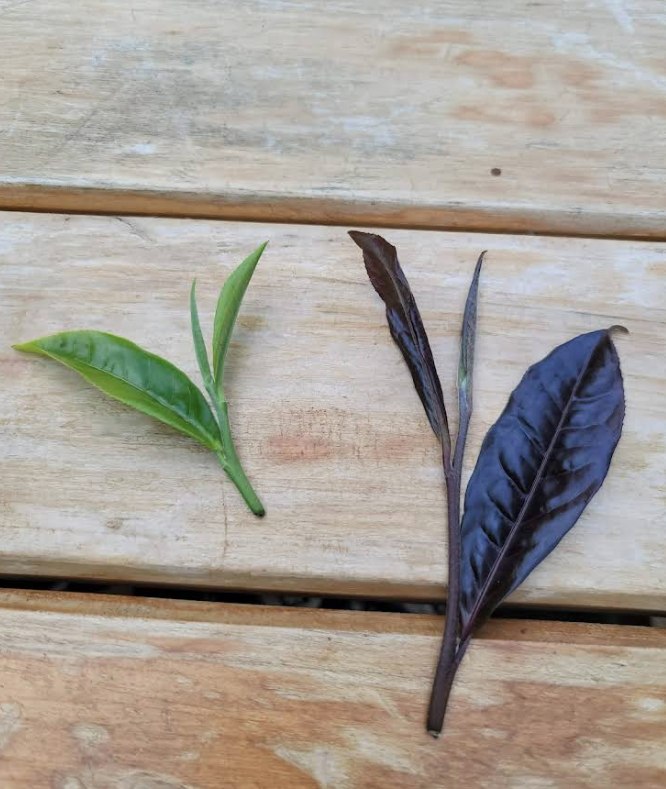
At the farm, everything is done by hand, true to orthodox tea processing traditions.
We started with tea picking, where we were taught how to identify the right leaves depending on the tea grade being produced.
- For regular tea, the rule is: two leaves and a bud.
- For premium teas (sometimes referred to as the “Champagnes of tea”), it’s usually one leaf and a bud.
Premium grades are more flavorful, less bitter, and often reserved for export or high-end boutique tea shops.
Processing of Purple Tea
After picking, the fresh leaves go through several traditional steps:
1. Withering
Withering softens the leaves and reduces moisture. On small-scale farms like the one we visited, this is often done in a hot wok to gently heat and wilt the leaves.
Unlike mass production, where leaves might sit out in the sun for hours, wok withering is faster and gives the farmer more control.
2. Rolling
This was the fun part. We rolled the leaves on a mesh tray, not to flatten them, but to create small cuts and bruises that release enzymes and allow the tea to oxidize naturally.
The goal is to maintain the leaf’s shape, so it doesn’t fall apart, unlike in commercial CTC (crush, tear, curl) teas.
Rolling also increases surface area for better flavor extraction during steeping.
3. Oxidation (Optional)
Not all purple tea is oxidized — in fact, it depends on the style you want to produce. Purple tea can be processed like:
- Green tea (no oxidation)
- Oolong tea (partial oxidation)
- Or even black tea (full oxidation)
Oxidation affects both the flavor and caffeine level.
For example, black and oolong teas are higher in caffeine and have bolder flavors, while green, white, and purple teas are gentler and more floral.
4. Drying
Once the desired oxidation level is achieved, the leaves are air-dried for about 1 to 1.5 hours, then finished in an oven.
This final step locks in flavor and removes any remaining moisture, preserving the tea without any additives or preservatives.
Tea Grading
Tea isn’t just about the type of leaf — where the leaf came from on the tea bush also matters.
- Younger leaves and buds have more antioxidants and lighter flavors.
- Mature leaves are often more bitter and used in cheaper teas.
Farmers sort tea based on the size and part of the leaf harvested. This grading system affects everything from flavor to market value.
Health Benefits of Purple Tea
What makes purple tea more than just pretty is its health profile. Some of the claimed (and researched) benefits include:
- Anti-aging properties (thanks to anthocyanins)
- Weight loss is supported by boosting metabolism
- Cardiovascular benefits, like improving blood circulation
- Neuroprotective effects that may support brain health
- Lower risk of caffeine crashes compared to black tea or coffee
That makes it a solid choice for health-conscious tea lovers who still want a nice warm cup of something with flavor.
Tasting Notes
Purple tea is surprisingly smooth and easy to enjoy without sugar or milk. It has mild floral notes, a light body, and a refreshing aftertaste.
Depending on how it’s processed, you might notice:
- Rose or jasmine-like flavors
- A hint of wood or earthiness
- Very low bitterness (especially compared to green tea)
Even if you’re not a tea snob, purple tea is easy to like. It’s not overpowering, and it doesn’t need sweeteners to be drinkable.
Read More Here: Kenyan Purple Tea Explained
Farmer Impact
Purple tea isn’t just about flavor and health. It’s also about supporting Kenyan farmers.
Because it’s a high-value specialty crop, purple tea allows smallholder farmers to earn more per kilogram compared to traditional black tea. Many farmers have adopted it to diversify their income and meet growing global demand for wellness teas.
Why You Should Try Purple Tea
Visiting a purple tea farm shows you just how much thought, tradition, and hard work go into that cup you sip at home.
It’s healthy, unique, and Kenyan — and if you ever get a chance to visit a farm, roll your own batch, or just taste a fresh brew, don’t miss it.
Leave a Reply